
Most permanent roofline lighting near Lake Stevens gets designed around a single approach: the street a home faces, the driveway a visitor pulls into, the view from the front walkway. That works fine for a mid-block home with one clear front elevation. It doesn’t work the same way for a corner lot, where the house is visible from two different streets at once, often from angles that show completely different sides of the roofline.
A design built around only one of those two views ends up looking unfinished, or even a little lopsided, from the other. This is one of the more common planning gaps corner-lot homeowners in Lake Stevens run into without realizing it until the lights are already up.
Why a Corner Lot Sees Roofline Lighting Differently Than a Mid-Block Home
A mid-block home usually has one dominant elevation that faces the street, with the side and rear elevations largely hidden from public view by neighboring houses or fencing. Roofline lighting on that kind of lot can reasonably focus most of its attention on that single front-facing section.
A corner lot doesn’t work that way. Both street-facing sides of the house are exposed to public view, often to two entirely different sets of passing traffic and pedestrians. A roofline section that would be a minor secondary detail on a mid-block home can be a primary view for an entire second street’s worth of people on a corner lot.
What Changes When a Home Has Two Street-Facing Approaches
The practical effect is that a corner lot really has two front elevations instead of one, even though only one of them may have the actual front door. Someone approaching from the side street sees that elevation first and forms their impression of the house from it, the same way someone approaching from the main street forms theirs from the front.
Treating one of these as the real front and the other as an afterthought usually shows. A roofline that tapers off or stops abruptly at the corner, rather than carrying a coherent design around the turn, reads as incomplete from whichever angle gets less attention.
Why One Strong Focal Point Doesn’t Always Work Here
On a standard lot, a single strong focal point, a prominent peak or gable, often makes for the cleanest design. On a corner lot, a single focal point visible from only one of the two streets can leave the other approach with little to look at.
This doesn’t necessarily mean a corner lot needs two separate focal points competing for attention. It often means the roofline needs to be read as one continuous line that wraps the corner convincingly, so that neither street feels like it’s seeing the back half of someone else’s display.
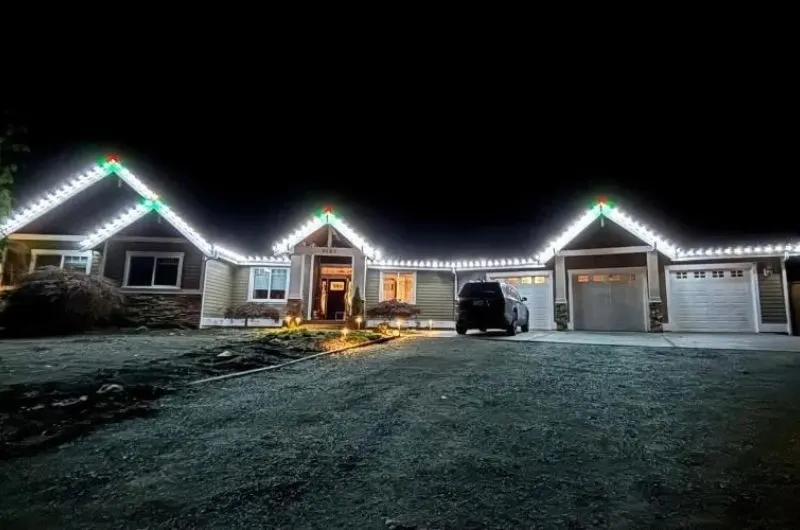
How Roof Shape and Corner Placement Interact
The way a home’s roofline actually turns the corner matters here. A hip roof that wraps smoothly around the corner gives a natural continuous line to follow from either street. A roofline with a hard break at the corner, such as a gable ending abruptly where a different roof section begins, creates a visible seam that either needs to be planned around or deliberately treated as a transition point in the design.
Homes set at an angle to both streets, common on lots at a curved intersection or a non-standard corner, add another variable, since neither street offers a completely straight-on view of either elevation.
What to Ask Residential Outdoor Lighting Companies in Lake Stevens About Corner Lots
If you’re comparing residential outdoor lighting companies in Lake Stevens for a corner lot, it’s worth asking a few specific questions rather than assuming every company plans the same way.
Ask whether they walk the property from both streets before finalizing a design, not just from the driveway. Ask how they handle the actual corner of the roofline, whether that’s a continuous wrap or a planned transition point. Ask whether they can show you how the plan will look from the secondary street, not just the main one. And ask whether the design changes at all based on which street sees more foot or vehicle traffic, since that can reasonably shift where the strongest visual emphasis goes.
Signs Your Corner Lot Layout Needs a Two-Angle Design
A few property characteristics are worth flagging before a design gets finalized. If your home’s roofline changes shape, height, or pitch as it turns the corner, that transition point needs a specific plan rather than a default continuation of whatever’s happening on the main elevation.
If your secondary street sees regular foot traffic, a nearby bus stop, or is a common walking route, that view deserves the same consideration as the main street-facing side. And if your home sits at an angled or non-standard corner rather than a clean 90-degree intersection, it’s worth having someone walk both approaches in person rather than relying on a design based on photos or a quick drive-by.
Frequently Asked Questions
Does a corner lot cost more to light than a standard lot?
It depends on the roofline and how much of the home is visible from each street, since that determines how much of the house the design actually needs to cover. A qualified assessment of the specific property is the only reliable way to know.
Can roofline lighting wrap around a corner without looking disjointed?
Yes, particularly on homes with a hip roof or a roofline that turns smoothly. Homes with a hard break at the corner may need the transition treated as a deliberate design point rather than expecting a seamless wrap.
Which street should get the stronger focal point if I have to choose?
This usually comes down to which approach sees more regular traffic or serves as the home’s primary identified entrance, though both approaches typically deserve some consideration rather than one being ignored entirely.
Do angled corner lots need a different approach than standard 90-degree corners?
Often yes. An angled lot means neither street gets a fully straight-on view of either elevation, which usually calls for an in-person walkthrough from both approaches rather than a design based on a single vantage point.
How do I know if my current roofline lighting looks unfinished from the second street?
The clearest way is to physically walk or drive the secondary street after dark and look at the house the way someone unfamiliar with it would. A roofline that trails off or stops abruptly partway around the corner is the most common sign.
Get Roofline Lighting Planned for Both Sides of Your Corner Lot
A corner lot in Lake Stevens deserves a permanent roofline lighting design that holds up from both streets, not just the one the front door faces. Rusty’s Holiday Lights evaluates every approach a property actually has, corner lots included, as part of its permanent lighting design process.
Call 425-374-1603 anytime, or reach out through our contact form.